 +86 18030182217
 +86 18030182217
 sandydcsplc@gmail.com


Description
. Many products are not yet available. Please contact us to learn more about them
. In case of any inconsistency between the product model and the displayed picture, the model shall prevail. For specific product pictures, please contact us and we will take photos of the goods for confirmation
. We share multiple warehouses around the world, so please understand that it may take several hours to accurately return it to you. Of course, we will respond to your concerns as soon as possible
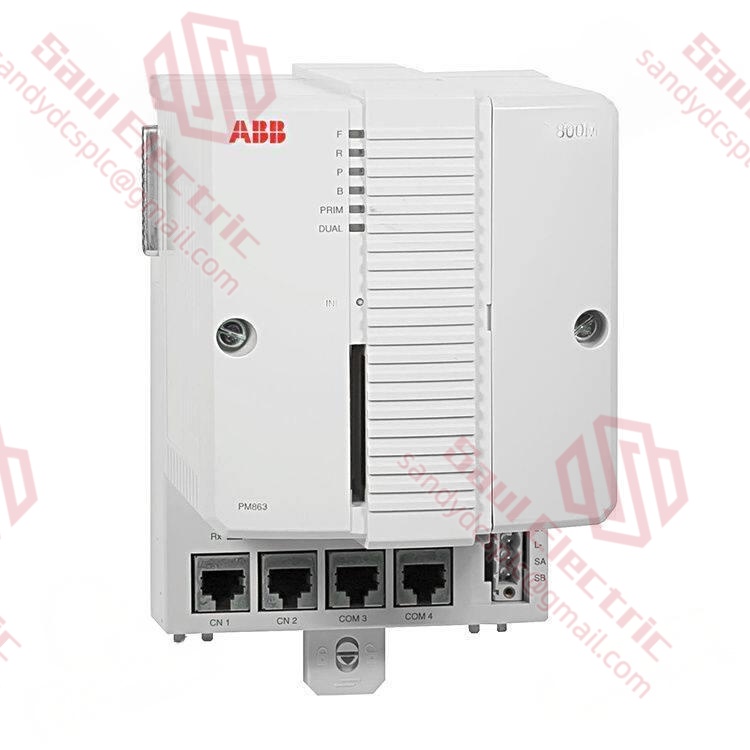
- Model: ABB 3BSE088381R1 (PM863K01)
- Brand: ABB (Switzerland-Sweden)
- Series: AC 800M High-Performance Controller Series
- Core Function: High-speed redundant process control CPU for complex DCS applications. Condition: New Surplus, not refurbished.
- Type: Controller Module (CPU)
- Key Specs: 2x Ethernet Ports (CN1, CN2) | Redundancy Supported | ControlIT/Firmware V5.x & V6.x Compatible
The ABB PM863K01 (3BSE088381R1) acts as the high-performance central processing unit for the AC 800M series, engineered for demanding redundant control systems in critical infrastructure. This controller executes complex logic and manages high-volume data traffic across distributed I/O networks, making it a standard in power generation, petrochemical, and pulp & paper industries.Distinguishing itself from earlier models, the PM863K01 offers enhanced processing speed and larger memory capacity to handle advanced control strategies and extensive communication loads. Its dual Ethernet port architecture ensures seamless switchover during primary module failures, minimizing process disruption. For plants where milliseconds of downtime translate to significant financial loss, this module provides a reliable, robust backbone. We supply verified surplus units to bridge the gap between discontinuation notices and new procurement lead times.
Key Technical Specifications
| Parameter Name | Specification Value |
|---|---|
| Part Number | 3BSE088381R1 |
| Product Type | PM863K01 Processor Module |
| Processor Speed | 32-bit RISC, higher clock speed than PM86x predecessors |
| Memory Capacity | 64 MB RAM (User Memory) |
| Communication Ports | 2 x Ethernet (10/100 Mbps), 2 x Serial (RS-232/485) |
| Redundancy Support | Yes (High Availability configuration) |
| Supported Protocols | Modbus TCP, OPC, ControlIT, FTP, HART |
| Power Consumption | Approx. 14 W (at 5 V DC) |
| Operating Temperature | 0°C to +60°C |
| Storage Temperature | -40°C to +85°C |
| Humidity Range | 5% to 95% (non-condensing) |
| Certification | CE, UL, CSA, Ex (Zone 2) |
Recommended Spares & Stocking Advice
As a Spare Parts Inventory Manager, I classify the ABB PM863K01 as an A-Class Critical Item. Its role as the system brain, combined with increasing lead time variability from original manufacturers, demands a proactive stocking strategy. Here is my recommendation:
- Primary Controller (PM863K01):
- Recommended Qty: 1–2 units per site (Buffer stock).
- Purchasing Notes: Treat this as an insurance policy. Do not wait for a failure to source. Given the lifecycle stage of the AC 800M series, prioritize “New Surplus” with verified firmware versions over refurbished units to avoid early-life failures.
- Est. Lead Time: 6–12 weeks for new orders; immediate availability for verified surplus stock.
- Redundant Sync Cable & Termination Units:
- Recommended Qty: 2 sets.
- Purchasing Notes: Often overlooked. If the sync cable fails, redundancy is lost even if the CPU works. Keep these as consumable spares.
- Est. Lead Time: 2–4 weeks.
- Compact Flash Memory Card (if applicable for logging):
- Recommended Qty: 1 unit.
- Purchasing Notes: Ensure compatibility with the specific firmware revision running on your plant floor. Mismatched card types can cause boot loops.
- Est. Lead Time: 1–2 weeks.
Strategic Insight: For facilities running older ControlIT versions, execute a Last-Time-Buy analysis immediately. Vendor consolidation agreements often fail to cover obsolete firmware dependencies. I recommend cross-site sharing protocols if you operate multiple plants; pooling two units for three sites reduces carrying costs while maintaining coverage for catastrophic failures. Always verify the firmware version (e.g., V5.0.2 vs V6.0.1) before deployment to prevent communication timeouts with existing I/O modules.
Quality Control & Inspection Process
To eliminate doubts about “surplus stock” quality, we adhere to a strict transparency protocol for every ABB PM863K01 unit shipped:
- Inbound Inspection: We verify traceability against original packing lists and customs declarations. Our team performs anti-counterfeit checks on serial numbers and labels, followed by a rigorous visual inspection for corrosion, scratches, repair marks, or yellowing. We confirm the presence of all original accessories, including manuals and factory certificates.
- Live Functional Testing: Using a dedicated test rack featuring an original ABB AC 800M simulation system, we conduct a full power-on self-test (checking LED indicators and startup sequences). We verify communication handshakes via Modbus TCP and ControlIT, simulate full-range I/O signals, and run a continuous load test for over 24 hours while recording temperature rise. A formal Test Report is generated for every unit.
- Electrical Parameter Testing: We measure insulation resistance using a 500V megohmmeter (target >10MΩ), verify ground continuity, and perform withstand voltage tests where applicable to ensure electrical integrity.
- Firmware/Program Verification: We read and record the exact firmware version (e.g., V5.1.3). If multiple versions exist, we note the specific build. We also photograph DIP switch and jumper settings to document the configuration backup.
- Final QC & Packaging: An inspector signs off on the unit. We seal it in an anti-static bag, pack it with bubble wrap and a sturdy carton, and attach a “QC Passed” label with the inspection date. We can provide test videos and photos for your review upon request.
Technical Pitfall Guide: Veteran Engineer’s Advice
Replacing a PM863K01 isn’t just a swap-and-go operation. I’ve seen projects stall for days due to avoidable errors. Here are the critical risks to manage:
- Firmware Rev Mismatch:
- Issue: A new module’s firmware might be too new or too old, causing communication errors with your existing ControlIT system or I/O modules.
- Avoidance: Record the old module’s firmware version before removal (check the label or read via software). Specify the acceptable firmware range when purchasing. If a mismatch occurs, contact the supplier to flash or downgrade the firmware immediately.
- Real Case: “I saw a project where an engineer swapped a CPU, and the PLC kept reporting ‘Communication Timeout’. It took two days to realize the firmware had bumped from V5.0 to V5.2, causing a minor protocol shift with the old I/O drivers.”
- DIP Switch / Jumper Configuration Errors:
- Issue: Factory default settings rarely match site requirements (e.g., node address, baud rate, terminating resistors).
- Avoidance: Take a photo of the old module’s DIP switches and jumpers before swapping. Verify and replicate the configuration on the new module before powering up. Special note: Bus terminating resistors (120Ω) must only be at the two ends of the bus.
- Tone: “This is a rookie mistake, but it happens all the time. Take a picture! Take a picture! Take a picture! Important things are worth repeating.”
- Terminal / Cable Incompatibility:
- Issue: Interfaces on new and old modules might look identical but have subtle pinout changes or different connector types.
- Avoidance: Check the Wiring Diagram in advance. Prepare adapter terminals or be ready to recrimp wires. Note shield grounding methods (single-ended vs. double-ended).
- Warning: “With some ABB modules, even if the models look similar, the pinouts might differ between revisions. Always check the manual; don’t just guess.”
- Power Supply Spec Differences:
- Issue: The new module might draw slightly more power, pushing an already maxed-out power supply over the edge.
- Avoidance: Calculate the total rack power consumption and leave a 20% margin. If nearing the limit, consider adding a supplementary power module.
- Data: “For example, a PM863K01 draws about 14W. If you have a rack with 10 high-load I/O modules, the total could hit 70W, making a marginal 24V/2.5A supply inadequate.”
- Electrostatic Discharge (ESD):
- Issue: Module fried by static electricity due to lack of ESD precautions.
- Avoidance: Wear an anti-static wrist strap. Work on an anti-static mat. Be especially careful in dry winter conditions.
- Scare tactic: “I watched an engineer touch a module without a strap. The moment it powered on, it smoked. That was $3,000 down the drain.”
- WhatsApp: +86 18030182217
- Email: sandydcsplc@gmail.com
- Phone: +86 18030182217
- Wechat: +86 18030182217
- Website: www.xiongbaparts.com