 +86 18030182217
 +86 18030182217
 sandydcsplc@gmail.com


Description
2. Product Core Brief
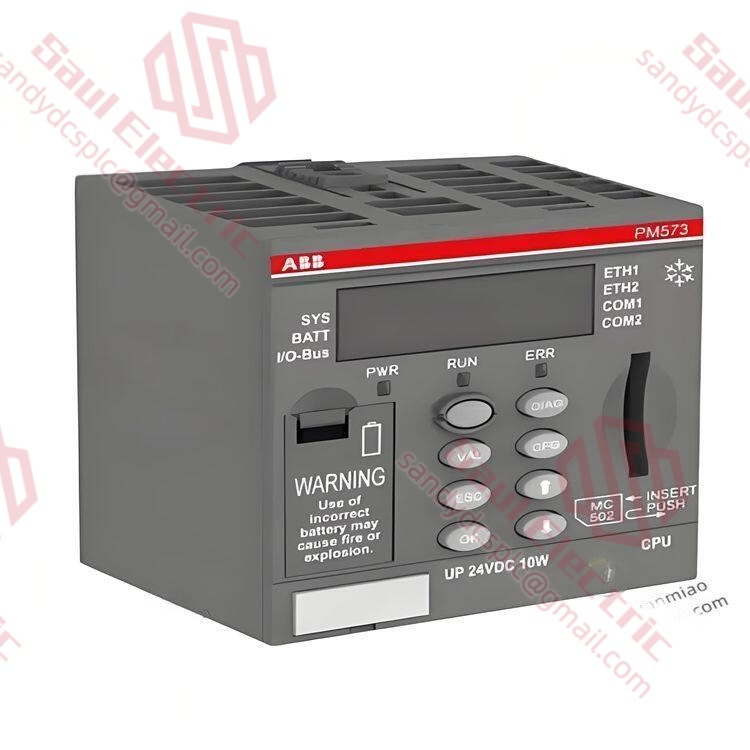
- Model: ABB PM573-ETH (1SAP130300R0271)
- Brand: ABB (Switzerland-Sweden)
- Series: AC500-eCo Economical Controller Series
- Core Function: Central processing unit for AC500-eCo systems with dual Ethernet ports and integrated I/O. Condition: New Surplus, Not Refurbished.
- Type: CPU Module (Processor)
- Key Specs: 24 V DC Supply | 2x Ethernet (RJ45) | 512 KB Program Memory | Integrated Digital I/O
3. Key Technical Specifications
| Parameter Name | Specification Value |
|---|---|
| Order Number | 1SAP130300R0271 |
| Supply Voltage | 24 V DC (-20% / +25%) |
| Power Consumption | Approx. 4.5 W (at 24 V, no load) |
| Program Memory | 512 KB |
| Data Memory | 1 MB |
| Execution Speed | 0.08 µs per boolean instruction |
| Communication Ports | 2x Ethernet (RJ45, TCP/IP, Modbus TCP), 1x RS-232/485 (COM1) |
| Integrated I/O | 10 Digital Inputs (24 V), 6 Digital Outputs (24 V, 0.5 A) |
| Expandable I/O | Up to 3 local extension modules (FBP bus) |
| Battery Backup | Supercapacitor (no battery required for typical retention) |
| Mounting | DIN Rail (35 mm) |
| Operating Temperature | -20°C to +60°C (-4°F to +140°F) |
| Protection Class | IP20 |
4. Product Introduction
The ABB PM573-ETH (Order No. 1SAP130300R0271) is a high-performance central processing unit designed for the AC500-eCo series, targeting cost-sensitive yet demanding automation applications. It distinguishes itself with dual Ethernet ports, enabling flexible network topologies like daisy-chaining without external switches, and includes integrated digital I/O to reduce system footprint.
Unlike refurbished units that may suffer from degraded supercapacitors or undocumented firmware modifications, our inventory consists of New Surplus modules sourced from authorized project cancellations. The “ETH” designation confirms native Ethernet capability, a critical feature for modern SCADA integration. We ensure every unit is factory-sealed or rigorously tested to match original performance specifications, providing a reliable, low-latency replacement for maintaining critical packaging, material handling, and water treatment systems.
5. Troubleshooting Quick Reference
| Symptom | Possible Cause | Part Relevance | Quick Check Method | Recommendation |
|---|---|---|---|---|
| No LEDs lit | Power supply failure or reversed polarity | ❌ Low | Measure voltage at terminal block; check polarity (+/-). | Verify 24 V DC supply is stable; check fuse on power source. |
| RUN LED off, ERR LED red | Hardware fault or corrupted program | ✅ High | Connect via Control Builder; read Diagnostic Buffer. | If “Watchdog Timeout” appears, replace CPU; if “I/O Error,” check extension modules. |
| Ethernet port unresponsive | IP conflict or cable fault | ⚠️ Medium | Ping IP address; swap Ethernet cable; check switch port LEDs. | Verify IP settings match project configuration; try the second Ethernet port. |
| Program loss after power cycle | Supercapacitor failure or deep discharge | ⚠️ Medium | Check time since last power-up; verify if program was saved to non-volatile memory. | Ensure “Retain” settings are correct in software; if supercapacitor is dead, replace CPU. |
| Serial comms timeout | Baud rate mismatch or wiring error | ⚠️ Medium | Check COM1 settings in software; verify wiring (Tx/Rx cross-over). | Match baud rate in software to hardware settings; check shield grounding. |
Closing Suggestion: If the above steps do not isolate the issue, we recommend contacting technical support with:
- A photo of the LED status pattern on the CPU.
- A screenshot of the error code from the Control Builder diagnostic buffer.
- The exact firmware version currently running (if accessible).
Our engineers will respond within 2 hours.
6. Frequently Asked Questions (FAQ)
Q1: What is the difference between PM573-ETH and the standard PM573?
A: The primary difference is communication. The PM573-ETH (1SAP130300R0271) features two built-in Ethernet ports supporting TCP/IP and Modbus TCP, whereas the standard PM573 typically relies on serial communication or requires an add-on communication module for Ethernet. In my experience, the dual-port ETH model is superior for line topology setups, eliminating the need for an external switch and reducing cabling costs.
A: The primary difference is communication. The PM573-ETH (1SAP130300R0271) features two built-in Ethernet ports supporting TCP/IP and Modbus TCP, whereas the standard PM573 typically relies on serial communication or requires an add-on communication module for Ethernet. In my experience, the dual-port ETH model is superior for line topology setups, eliminating the need for an external switch and reducing cabling costs.
Q2: Is this module hot-swappable?
A: No. The PM573-ETH is the central controller; removing it while powered will stop the entire PLC process and likely cause a machine fault or safety trip. You must power down the entire rack before replacing the CPU. Attempting a live swap can damage the FBP (Field Bus Protocol) connectors on the backplane. Plan for a scheduled downtime window of at least 30 minutes for replacement and download.
A: No. The PM573-ETH is the central controller; removing it while powered will stop the entire PLC process and likely cause a machine fault or safety trip. You must power down the entire rack before replacing the CPU. Attempting a live swap can damage the FBP (Field Bus Protocol) connectors on the backplane. Plan for a scheduled downtime window of at least 30 minutes for replacement and download.
Q3: Does this CPU require a battery for data retention?
A: No, the PM573-ETH uses a built-in supercapacitor to retain data (RAM content and real-time clock) during short power outages. This eliminates the need for periodic battery replacements, a common maintenance task with older PLCs. However, if the power is off for an extended period (weeks), data may be lost if not saved to the non-volatile flash memory. Always ensure your project is compiled with “Download to Flash” enabled for critical applications.
A: No, the PM573-ETH uses a built-in supercapacitor to retain data (RAM content and real-time clock) during short power outages. This eliminates the need for periodic battery replacements, a common maintenance task with older PLCs. However, if the power is off for an extended period (weeks), data may be lost if not saved to the non-volatile flash memory. Always ensure your project is compiled with “Download to Flash” enabled for critical applications.
Q4: Why choose New Surplus over Refurbished for this specific model?
A: The supercapacitor in the PM573-ETH degrades over time, even when not in use. Refurbished units often have unknown storage histories; a unit sitting on a shelf for 5 years may have a depleted supercapacitor that fails to hold charge upon installation, leading to immediate program loss. New Surplus units are factory-fresh, typically stored in climate-controlled environments, and retain their full capacitance. The risk of unexpected downtime due to a failed retention circuit far outweighs the minor cost savings of a refurbished unit.
A: The supercapacitor in the PM573-ETH degrades over time, even when not in use. Refurbished units often have unknown storage histories; a unit sitting on a shelf for 5 years may have a depleted supercapacitor that fails to hold charge upon installation, leading to immediate program loss. New Surplus units are factory-fresh, typically stored in climate-controlled environments, and retain their full capacitance. The risk of unexpected downtime due to a failed retention circuit far outweighs the minor cost savings of a refurbished unit.
Q5: Can I expand this CPU with standard AC500 modules?
A: Partially. The PM573-ETH belongs to the AC500-eCo (economical) series. It supports up to 3 local extension modules specifically designed for the eCo range (e.g., CM572, DM572). It is not compatible with the full range of high-end AC500 S500 I/O modules used with PM590 or PM564 controllers. Always verify the module compatibility list in the ABB hardware manual before ordering extensions.
A: Partially. The PM573-ETH belongs to the AC500-eCo (economical) series. It supports up to 3 local extension modules specifically designed for the eCo range (e.g., CM572, DM572). It is not compatible with the full range of high-end AC500 S500 I/O modules used with PM590 or PM564 controllers. Always verify the module compatibility list in the ABB hardware manual before ordering extensions.
Q6: What software do I need to program this?
A: You need ABB Control Builder (specifically the version compatible with AC500-eCo). While newer versions of Control Builder (V6+) generally support legacy hardware, some very old firmware versions on the PM573-ETH might require a specific service pack or an older CB version (e.g., V2.x or V3.x) for initial commissioning. Check the ABB compatibility matrix. If the CPU has an unknown firmware version, we recommend having the engineering laptop ready with multiple CB versions installed.
A: You need ABB Control Builder (specifically the version compatible with AC500-eCo). While newer versions of Control Builder (V6+) generally support legacy hardware, some very old firmware versions on the PM573-ETH might require a specific service pack or an older CB version (e.g., V2.x or V3.x) for initial commissioning. Check the ABB compatibility matrix. If the CPU has an unknown firmware version, we recommend having the engineering laptop ready with multiple CB versions installed.
Q7: How do I reset the IP address if I lost the project file?
A: If you cannot connect due to an unknown IP, you can use the hardware reset procedure. Typically, this involves holding a specific button (or cycling power with a jumper setting, depending on the exact revision) while powering up to revert to factory default IP settings. Consult the “Installation and Commissioning” manual for the specific dip-switch or button sequence for 1SAP130300R0271. Note that this will not delete the user program, only the network settings.
A: If you cannot connect due to an unknown IP, you can use the hardware reset procedure. Typically, this involves holding a specific button (or cycling power with a jumper setting, depending on the exact revision) while powering up to revert to factory default IP settings. Consult the “Installation and Commissioning” manual for the specific dip-switch or button sequence for 1SAP130300R0271. Note that this will not delete the user program, only the network settings.
Contact info
- WhatsApp: +86 18030182217
- Email: sandydcsplc@gmail.com
- Phone: +86 18030182217
- Wechat: +86 18030182217
- Website: www.xiongbaparts.com