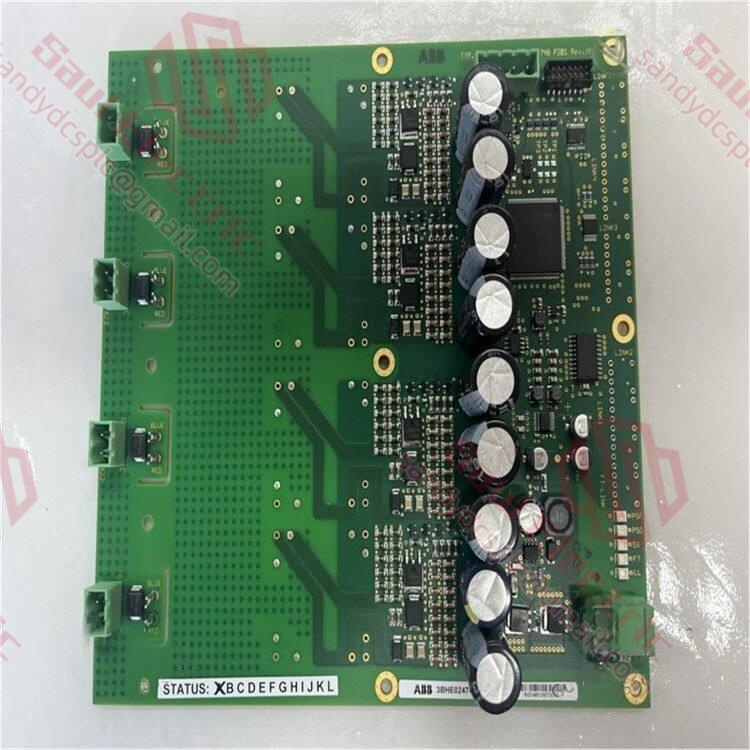
At the core of power regulation and complex industrial automation, the ABB GDC801A101 3BHE024747R0101 is far more than a standard hardware component—it acts as the computing and decision-making center of the entire control system. As a key part of ABB’s premium industrial control portfolio, it takes on the heavy lifting of precision control and signal processing, laying a solid foundation for uninterrupted, stable industrial operations. Truth be told, this module comes equipped with mature digital signal processing hardware that runs complex control algorithms efficiently. It adapts smoothly to everything from basic logic interlock control to real-time process management with strict response requirements, covering the diverse needs of most industrial control scenarios.
From the earliest design stages, the engineering team prioritized adaptability to harsh working conditions. Its metal enclosure and reinforced internal structure allow continuous operation in workshops and power stations with dust and fluctuating temperatures, without performance drift caused by external disturbances. Rooted in ABB’s decades of expertise in power and automation, this module supports mainstream industrial communication protocols right out of the box. Integrating it into existing on-site automation architectures rarely requires complex modifications, boosting on-site operation efficiency and cutting lifetime usage and renovation costs. For projects aiming to optimize industrial control systems and implement lean operations, it stands out as a practical choice that balances performance and deployability.
Technical Specifications
Parameter
Details
Part Number
ABB GDC801A101 3BHE024747R0101
Manufacturer
ABB
Product Type
Industrial Control Module / Exciter Controller Module
Operating Voltage
Up to 48V DC or 380V AC (configuration-dependent)
Input Current
1A or 20A (mode-dependent)
Output Current
0.5A or 50A (mode-dependent)
Communication Interface
RS-485, Modbus-RTU
Power Consumption
<2W
Operating Temperature
-25°C to +60°C (some sources list -20°C to +50°C; follow official manual)
Protection Rating
IP20 or IP54 (structure version-dependent)
Dimensions
Approx. 140mm × 75mm × 30mm (other sources note 150×100×200mm, 170×100×115mm; verify with OEM before purchase)
Weight
Approx. 0.2kg to 2.5kg (configuration-dependent)
Control Algorithm
PID Control Algorithm
Key Features and Advantages
The core strength of this module lies in its balanced mix of durability and intelligent functionality. Built with industrial-grade components and a vibration- and interference-resistant structure, it maintains stable output across a wide temperature range from -25°C to +60°C. Its IP54 maximum protection rating also defends against most workshop dust and light moisture, making it well-suited for tough industrial sites.
Precision regulation is its defining highlight. Equipped with advanced digital signal processing and the classic PID control algorithm, it delivers fine-tuned adjustment of voltage, current and process variables. This is critical for generator excitation systems and continuous production lines, as it directly shapes equipment stability and energy efficiency. Think about it: even a small deviation in excitation current for large generators can destabilize grid voltage, and the module’s precision stops this kind of risk before it emerges.
In real-world projects, integration difficulty often sets the timeline, and this module eases that pain point. Compatible with industry-standard protocols like RS-485 and Modbus-RTU, it enables seamless data exchange and remote real-time monitoring when connected to legacy control systems, with no need to overhaul existing setups. Its modular design and intuitive interface lower the barrier for installation, configuration and routine maintenance, cutting down on downtime for setup and tuning. Isn’t this adaptability exactly what older production lines need for cost-effective upgrades?
Safety is also well covered. The module follows international safety standards including CE, UL and CSA throughout design and production, making it compliant for industrial use across the globe. Combining a rugged build, precise control, easy integration and safety certification, this module delivers a high-value industrial control solution.
Application Areas
This module finds a home in nearly every scenario that demands strict control precision and operational stability.
The power and energy sector is its primary application. In thermal, hydro and renewable power plants, it mainly handles generator excitation control, stabilizing grid voltage and improving generation efficiency by fine-tuning excitation current—making it a critical part of reliable power supply.
It also shows strong versatility in industrial automation. It can be fitted to various industrial machines and dedicated control platforms, handling complex sequential control, process regulation and real-time monitoring. In automated production lines, robotic control systems and large drive equipment such as frequency converter controls, it issues precise commands to keep production equipment running efficiently and in sync.
Continuous process industries like chemicals, oil and gas, metallurgy and water treatment have extremely high reliability requirements, and the module’s wide temperature tolerance and protection rating fit these environments perfectly. It monitors and regulates key process variables in real time, safeguarding production safety and uninterrupted operation, while acting as a core component to lift automation levels and operational efficiency in these foundational industries.
Related Products
ABB PPC907BE (3BHE024577R0101): High-performance processor module, works with GDC801A101 to support computing for highly complex automation systems
ABB PCD230A101 (3BHE022291R0101): Exciter regulation measurement board (CCM module), widely used in generator control to complement GDC801A101 functions
ABB UFC921 A101 (3BHE024855R0101): Dedicated power supply module, provides stable power for GDC801A101 and other paired control modules
GDD022: Digital I/O module, commonly used as a companion unit with GDC801A101 for digital signal acquisition and control output
GDQ021: Analog I/O module, works with GDC801A101 for analog signal acquisition and control signal output
AC800M: ABB high-end process controller, GDC801A101 can be embedded as a dedicated function module for collaborative operation
S800 I/O Series: ABB distributed I/O system, integrates with GDC801A101 to expand system I/O points and control capacity
Installation and Maintenance
Before installation, take the time to read through ABB’s official installation manual and safety codes in full—this is the foundation of avoiding on-site safety risks. First confirm that the on-site temperature, humidity and protection conditions meet the module’s requirements, then double-check the supply voltage: whether 24VDC or 380VAC, it must match the module’s configuration exactly. RS-485 communication cables should also be securely fastened to prevent communication failures from loose connections. Installers should have basic electrical and industrial control knowledge, and be familiar with on-site wiring standards.
Consistent, regular inspections work better than frequent checks to extend the module’s service life. Check the status indicators periodically, and clean dust from the chassis to avoid heat buildup. In practice, the module’s built-in diagnostic functions support predictive maintenance, catching potential faults early to stop minor issues from turning into full shutdowns. Always disconnect power before any maintenance work, and leave internal parameter adjustments and program modifications to technicians trained by ABB to reduce the risk of human error.
Product Guarantee
ABB applies strict quality control standards to the GDC801A101 3BHE024747R0101 module. Built with industrial-grade components and advanced manufacturing processes, it delivers long-term stable operation within its designed operating environment and offers a long service life. Genuine units come with direct access to ABB’s official technical support and after-sales service. Keep in mind that specific warranty periods, repair coverage and technical support terms should be confirmed in writing with ABB or its authorized distributors at the time of purchase, as terms can vary slightly by region and cooperation scheme. ABB’s brand and quality control system provide reliable backing for the module’s long-term use.

 +86 18030182217
 +86 18030182217
 sandydcsplc@gmail.com