
Introduction: Precision Temperature Sensing for Turbine Control
The GE IS400TCATHIACB is a high-density thermocouple analog input terminal board designed exclusively for the Mark VIe Distributed Control System (DCS) . As part of the IS400 series I/O family, this terminal board serves as the primary interface between field-mounted thermocouples (T/Cs) and the Mark VIe controller, translating millivolt-level thermal signals into digital process values for turbine protection, sequencing, and performance optimization.
This board is most commonly deployed in heavy-duty gas and steam turbine applications to monitor critical exhaust temperatures (typically using Type K thermocouples), ensuring the unit operates within safe thermal limits and meeting stringent emissions compliance. For plant engineers and procurement specialists, understanding the IS400TCATHIACB’s termination scheme, CJC methodology, and redundancy architecture is essential for maintaining asset reliability.
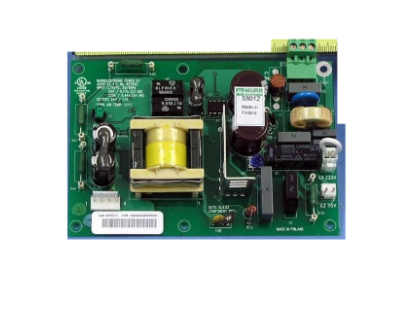
Model Code Breakdown: Decoding IS400TCATHIACB
The GE part number is structured to convey key attributes of the terminal board.
| Code Segment | Meaning | Interpretation for this Unit |
|---|---|---|
| IS400 | Product Series | Mark VIe I/O terminal board series (successor to the legacy IS200 platform). |
| TCAT | Board Function | Thermocouple Analog Terminal board – designed for millivolt T/C input conditioning and termination. |
| HI | Hardware Revision / Feature | Typically indicates the revision level or a specific hardware feature set (e.g., enhanced EMC protection). |
| ACB | Configuration / Coating | Often indicates Conformal Coating (AC) and specific variant (B). Conformal coating provides enhanced protection against humidity, dust, and corrosive atmospheres—critical for harsh power plant environments. |
⚠️ Important: The “ACB” suffix is a key differentiator. Boards with conformal coating are specified for high-humidity or coastal environments. Using a non-coated board in a marine environment can lead to premature corrosion and false thermocouple readings.
Key Technical Specifications
- Product Type: Thermocouple Analog Input Terminal Board (Passive termination and CJC board, requiring a separate PDBA power distribution board and IONet communication module).
- System Platform: GE Mark VIe DCS (Distributed Control System).
- Channel Density: Typically supports 24 or 32 thermocouple input channels (verify specific channel count per the variant; the TCAT board interfaces with the TCAC (Thermocouple Analog Converter) module via a backplane).
- Supported Thermocouple Types: Type J, K, T, R, S, B, E, N, and Tungsten-Rhenium (broad compatibility for various turbine OEMs).
- Cold Junction Compensation (CJC): Utilizes onboard precision thermistors for accurate cold junction compensation. The CJC sensor is located near the terminal block to minimize temperature gradients.
- Isolation: Galvanic isolation between the field inputs and the Mark VIe control system backplane, protecting the main controller from field-side voltage transients.
- Terminal Type: Fixed, high-reliability screw-clamp terminal blocks for secure field wiring.
- Conformal Coating: Present (per the “ACB” suffix) – a protective acrylic/silicone layer applied to the PCB to resist moisture, particulates, and chemical contaminants.
- Operating Temperature: Designed for 0°C to 60°C ambient within the control cabinet.
- Certifications: CE, UL, and suitable for Class I, Division 2 hazardous locations (per GE Mark VIe system certification).
Functional Role in the Mark VIe Architecture
The IS400TCATHIACB is a passive termination board. It works in conjunction with the TCAC (Thermocouple Analog Converter) I/O module, which is plugged into the controller’s VME rack. Here is how the system functions:
- Signal Conditioning: Field thermocouple leads (positive and negative) terminate directly onto the IS400TCATHIACB’s terminal strips. The board routes the millivolt signals to the adjacent TCAC converter module via a ribbon cable or backplane connector.
- Cold Junction Compensation (CJC): The biggest challenge with thermocouples is the “cold end.” This board features precision temperature sensors at the terminal block. The TCAC reads the board’s CJC temperature and applies the correct linearization algorithm (per thermocouple type) to compute the true process temperature.
- TMR (Triple Modular Redundancy) Integration: In high-availability turbine applications, three separate TCAC modules and three separate IS400TCATHIACB boards are connected to the same field thermocouples (using three independent wiring runs). The Mark VIe system votes on the three values to determine if a sensor or wiring channel has failed, allowing “run-through” capability during a single failure.
- Diagnostics: The board provides open-circuit detection for broken thermocouple wires. The controller can differentiate between a legitimate low-temperature reading and a broken wire, triggering a specific alarm to prevent unnecessary turbine trips.
Critical Installation and Wiring Best Practices
To obtain accurate, reliable temperature readings and avoid common pitfalls, follow these essential practices:
- Use the Correct Thermocouple Extension Wire: Crucial! The field wiring must match the thermocouple type (e.g., Type K wire for Type K sensors). Use of copper wire in place of extension-grade T/C wire introduces an additional cold junction at the terminal block, causing massive reading errors.
- Shield Termination: Use individually shielded, twisted-pair thermocouple extension cable. Terminate the shield to the designated ground lug on the IS400TCATHIACB board. Never ground the shield at the field sensor end (ground at the board end only to prevent ground loops).
- Maximize Signal-to-Noise Ratio: Route thermocouple wiring away from high-voltage power cables (VFD outputs, 480VAC motor leads) and ignition wiring. The millivolt signal is highly susceptible to EMI/RFI interference.
- Terminal Torque: Apply the specified torque to the screw terminals (typically 0.5–0.6 Nm). Loose connections cause thermal EMFs (parasitic voltages) that appear as false temperature spikes or drift.
- CJC Sensor Care: Ensure the area around the CJC sensor is clean and free of excessive heat from adjacent power devices. Any localized heating at the terminal block (e.g., from a nearby high-power resistor) will be misinterpreted as a change in cold junction temperature, shifting all 24 readings by the same offset.
- Conformal Coating Inspection: If the board has been in service for several years, visually inspect the conformal coating for cracks or peeling. If compromised, the board loses its environmental resistance—consider preventive replacement.
Common Applications
The GE IS400TCATHIACB is mission-critical in the following scenarios:
- Gas Turbine Exhaust Monitoring: Measuring T5/T48 exhaust gas temperatures for combustion monitoring, protection against overtemperature, and calculating turbine firing temperature.
- Steam Turbine Inlet/Extraction Temperature: Monitoring superheated steam temperatures for efficiency calculations and metal thermal stress management.
- Compressor Discharge Temperature (CDT): Tracking interstage temperatures in gas compressor trains.
- Generator Bearing Temperature (via T/Cs): While RTDs are common for bearings, some OEMs specify thermocouples for high-temperature bearing applications.
Procurement and Replacement Considerations
While Mark VIe is GE’s current active platform (now supported by GE Vernova), this specific IS400TCATHIACB is a high-turnover spare part due to field wiring damage, lightning strikes, and routine EOL (End-of-Life) replacement of terminal boards. Here is what to look for:
- Conformal Coating Verification (ACB): If your site is in a humid or coastal region, you must purchase the “ACB” variant. Verify the label visually upon receipt. Non-coated boards will fail within 6–12 months in high-humidity conditions.
- Revision Compatibility: While the IS400 series is generally backward-compatible, check the firmware revision of your TCAC converter module. Some later “HI” variants require the TCAC to be updated to the latest firmware to interpret the board’s EEPROM identification data correctly.
- Included Accessories: Confirm if the mating ribbon cable (connecting the terminal board to the TCAC module) and the screw terminal blocks are included. These are often lost during decommissioning and are hard to source separately.
- New vs. Surplus/Refurbished: GE Vernova still produces these, but lead times can extend to 12–16 weeks. High-quality refurbished units that have been ESD-tested, cleaned, and re-coated are an excellent alternative for emergency stock. Ensure the supplier provides a functional continuity test report.
- Fuse Check: Some variants include fuse protection on the CJC power line. Verify if your specific board has fuses and check their continuity before installation.
Conclusion
The GE IS400TCATHIACB is the quiet yet critical interface between the harsh thermal reality of a turbine and the digital intelligence of the Mark VIe controller. Its high-density design simplifies cabinet wiring, while its onboard CJC ensures the accuracy of the turbine’s primary protection parameters—exhaust temperature. By respecting wiring best practices (particularly the use of matching extension wire and single-point shielding), verifying conformal coating presence for your environment, and ensuring revision compatibility, you can keep your Mark VIe-based assets running safely and efficiently.